First
Excess water
Radar sees water even through clouds. The detector got 74 of the 79 cases in the flood golden set right.
Parametric insurance · Res. SSN 315/2026
Since July 23, 2026, Argentina has rules for parametric insurance: historical index frequency, an alternative source, an independent actuary and payment within 15 days of the event. Ucotron builds the index file and calculates each event with frozen data.
Index · hours with THI ≥ 79
Simulation
0h
Measuring the summer
Cumulative payout
0 %
of the sum insured
Payout clock
No event
From the resolution to the payout
According to the SSN's agro survey, no insurer sold a parametric product in 2024 or 2025. The resolution laid out the path: this is what each step requires and who provides it.
21/7/2026
Res. SSN 315/2026 adds item 23.8 to the insurance industry regulation.
The rule
23/7/2026
It appears in the Official Gazette and takes effect that day. Parametric moves to case-by-case authorization.
The rule
File
Index, thresholds, historical frequency across several baselines, basis risk and alternative source.
Ucotron
Validation
Registered with the SSN, validates the study and the index. The signature is theirs.
The actuary
Authorization
With the State as policyholder or over 1,000,000 UVA, it goes out without prior authorization and is reported within 30 days.
The insurer
Event
Ucotron calculates the index, freezes the data version and publishes it.
Ucotron
≤ 15 days
Fifteen calendar days from the event, not from when the data is published. A person decides.
The insurer
0
insurers sold parametric products in 2024 and 2025, per the SSN agro survey
15
calendar days to pay, counted from the event
≈ USD 1.42 M
1,000,000 UVA: from there, or with the State as policyholder, the product goes out without prior authorization
Res. SSN 315/2026 (RESOL-2026-315-APN-SSN#MEC), Official Gazette of July 23, 2026.
What we measured · heat on Rafaela dairy farms
The rule asks for historical frequency “over a statistically representative period” and doesn't say which. With 41 summers of ERA5 in the Rafaela cell, the choice of series changes the trigger frequency and nearly triples the premium. Choosing the baseline and justifying it is part of the file.
Hours with THI ≥ 79 per summerIllustrative shape
Summer that would have paidSummer with no payoutOutside the series
What we measured: hours with THI ≥ 79 between 12/1 and 2/28, hourly ERA5 via Open-Meteo, 41 summers (1985/86 to 2025/26), own calculation. The bars show the shape of the series; the frequencies and premiums are the calculated ones. Linear payout between 330 h and 480 h on a hypothetical sum of USD 10,000 per dairy farm, with hypothetical loadings.
When the event happens
The deadline runs from the event, and public data doesn't always arrive on time. Every step is recorded, with the data version that was used.
Day
0
of 15
Illustrative timing: each source has its own delay, and the policy sets which one is used and when.
The right instrument
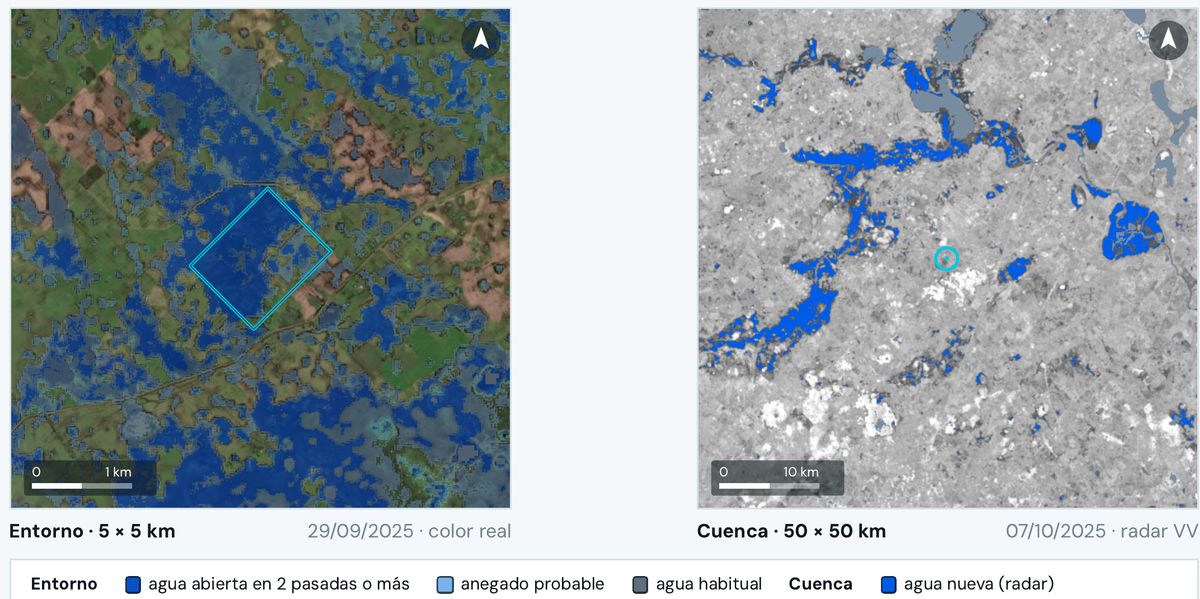
1The field: open water in two or more passes
2Event water, separated from the usual
3The same place, in the basin
4New water by radar, even through clouds
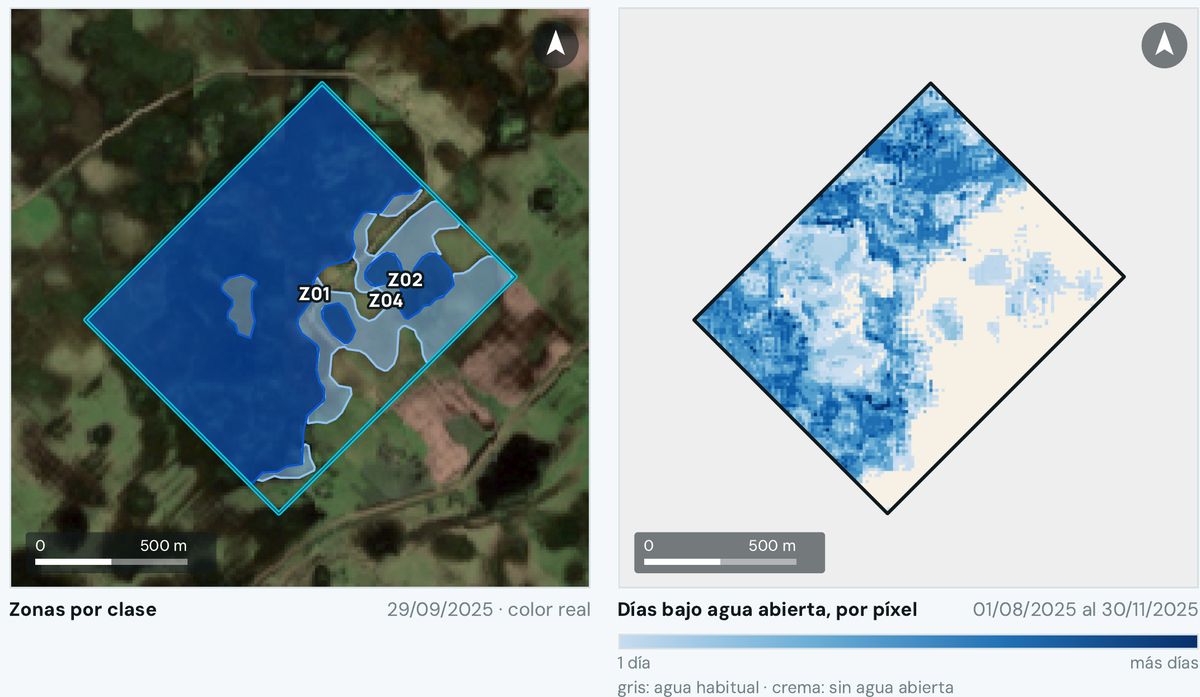
1Zones by class: open water and likely waterlogged
2Days under open water, pixel by pixel
3No open water in the whole period
74of 79
cases in the flood golden set correctly identified by the excess-water detector.
Each Sentinel-1 radar and Sentinel-2 optical pass is compared against a dry baseline of the same place. That separates event water from the usual lagoon and counts the days under water.
In this field: 66.8 ha, 68%, under open water for at least 37 days.
First
Radar sees water even through clouds. The detector got 74 of the 79 cases in the flood golden set right.
Second
Hourly ERA5 since 1940, cell by cell. Final data arrives two to three months later: payouts use the frozen version.
For verification only
The lightning record starts in 2018. It's enough to confirm an event, not to price an index.
Not yet
Our instrument is still weak for this. We don't offer it as an index.
What we provide and what we don't
Ucotron provides
What we don't provide
Once per product
Index, thresholds, frequency on several baselines, basis risk and fallback source, ready for the actuary.
Per season
Place by place across the whole policy term, with its data version.
Per event
The index value, frozen and signed, in time to pay within 15 days.
For insurers launching a parametric product, for the State as policyholder, and for the reinsurance behind it.
Parametric recipes
Excess water
When the index's measurement window closes.
Computes the index, freezes the data version and publishes it so a person can decide the payout.
APISigned PDF
Excess water
When the rainfall index exceeds its threshold or a river port goes on alert.
Alerts with the index value, its threshold and the alternate source.
EmailAPI
Heat
When the temperature-humidity index stays above its threshold for several hours in a row.
Counts the hours above the threshold and leaves the calculation ready to audit.
APISigned PDF